
Panasonic PT-VW540 Projector: What to Check Before Buying
Arshad Warsi
27 November 2026
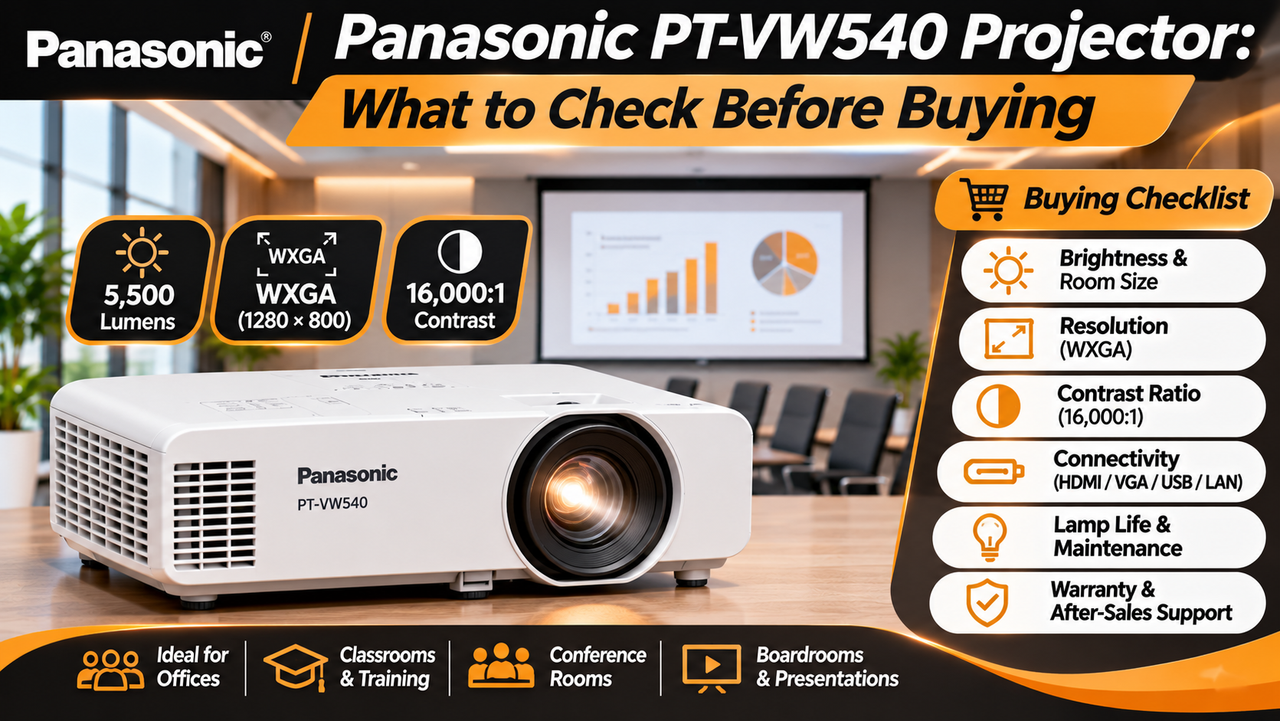
This guide is intended to help a business make a practical shortlist. It is not a substitute for the manufacturer’s manual, formal compliance advice or a site assessment where one is required. Product details should always be checked against the exact model being quoted.
1. Start with the model identity
Confirm that the product being quoted is the Panasonic PT-VW540 and that the model number matches the product label, manufacturer documentation and seller quotation. Projector names can be similar, and suffixes or regional versions may indicate differences. Ask for the official datasheet for the exact unit being supplied.
Check whether the quotation is for a new unit, refurbished unit or another condition. Confirm included accessories, power cable, remote control, lens cap and documentation where applicable. The listing title alone should not be treated as a complete package-content statement.
2. Match brightness to the room
Projector brightness is important, but the right choice depends on screen size, room lighting, image content and viewing distance. A meeting room with daylight entering through windows has different needs from a dark training room. Consider whether blinds or lighting controls are available before deciding that a higher-brightness device is the only solution.
Ask the supplier to explain the brightness rating in the official datasheet and the conditions under which it is measured. Do not compare figures from different manufacturers without checking their stated measurement standards and modes. A projector may have different output settings that affect brightness, colour and lamp life.
3. Check resolution and image format
The resolution should suit the content shown. Fine spreadsheets, engineering drawings and detailed presentations may need more image detail than simple slides. Check the native resolution and supported input signals in the manufacturer’s documentation. A supported input resolution is not necessarily the same as the projector’s native display resolution.
Confirm the aspect ratio of the screen and the content. If a laptop uses a different aspect ratio, the image may show bars or require scaling. Test the actual laptop, video source or conferencing equipment that the organisation plans to use.
4. Review installation and throw distance
Before ordering, measure the proposed projector-to-screen distance and screen dimensions. Use the manufacturer’s throw-distance information or calculator for the exact model and lens configuration. Do not assume a projector can fill any screen from any location. Ceiling height, mounting position, keystone correction and lens shift capabilities—if available—should be verified in the datasheet.
A ceiling installation should account for mounting hardware, ventilation, access for maintenance and cable routes. A tabletop setup may be easier to move but can create cable and placement issues. Ensure the projector’s vents are not blocked and that the mounting structure is suitable for the equipment weight.
5. Check connectivity and the complete presentation chain
List every source that will connect: office laptop, desktop, media player, document camera or conferencing device. Confirm the exact input ports and any required adapters. A connector that looks similar may not support the required signal or audio path. If audio is needed, determine whether it will come from the projector, an external speaker or a room sound system.
For wireless presentations, check whether the projector itself supports the desired method or whether a separate adapter is required. Confirm network security and compatibility with the organisation’s devices. Do not assume wireless presentation is included unless the official specification confirms it.
6. Compare total ownership and support
Ask about warranty, authorised service availability, replacement lamp or light-source cost, filters and maintenance intervals as applicable to the exact model. Projector running costs can include consumables, cleaning, installation, mounting accessories and downtime. Verify whether any warranty registration or installation requirement applies.
The current product page is a useful starting point for model-specific details, but buyers should confirm current stock, price, warranty and included accessories with Emerging Solutions before placing an order. If comparing alternatives, put their official datasheets side by side and check native resolution, brightness, throw ratio, connectivity and service terms rather than comparing only headline prices.
7. Build a specification comparison before requesting a quote
Create a simple comparison sheet for Panasonic VW540 projector. Include the exact model, the official manufacturer datasheet, intended application, required capacity, compatibility, included accessories, warranty and service arrangements. Record which details are confirmed and which still need a supplier response. This prevents a broad product description from being mistaken for a verified specification. For every shortlisted option, use the same questions and compare like with like. If one supplier quotes a device with an accessory and another quotes the base unit, make that difference visible before comparing prices.
8. Plan installation and staff readiness
Consider where the equipment will be placed, who will install it and who will use it each day. Check power, network, space, ventilation, access for maintenance and any safety requirements. Prepare a short operating guide for staff that covers normal startup, shutdown, consumable replacement, fault reporting and the support contact. A well-planned installation reduces avoidable interruptions and makes it easier to identify whether a problem is caused by the device, the connection or the surrounding workflow.
9. Evaluate support over the full product life
Purchase price is only one part of ownership. Ask how warranty claims are raised, where service is available, which consumables are genuine, how long common parts take to obtain and whether preventive maintenance is recommended. Keep the invoice, serial number, manuals and service history. If the device is essential to operations, decide what the team will do during downtime. A support plan is particularly important when the equipment is used daily or when a failure interrupts customer service.
10. Use a controlled acceptance test
Before accepting a new Panasonic VW540 projector solution, test it in the environment where it will actually be used. Use representative documents, content, users or operating conditions. Confirm that the required tasks can be completed, output is acceptable, connections remain stable and staff understand the basic process. Record any limitation and obtain written clarification for unresolved points. Acceptance testing is more useful than relying only on a demonstration prepared by the seller.
11. Keep product claims accurate and current
Product specifications, prices, availability, accessories and warranty terms can change. Before publishing a product comparison or issuing a quotation, recheck the manufacturer’s current documentation and the seller’s live listing. Avoid copying unverified claims from marketplace descriptions. Where a detail is unknown, say that it needs confirmation rather than filling the gap with an assumption. This protects buyers and keeps the information on the website trustworthy.
How to compare shortlisted options fairly
When comparing options for Panasonic VW540 projector, make sure each supplier is quoting the same scope. One offer may include installation, accessories or training while another may list only the base equipment. Put the model number, included items, delivery, setup, warranty and service terms into separate columns. Mark each point as confirmed, not included or awaiting clarification. This simple discipline prevents a low headline price from hiding costs that appear after the order is placed.
Use the manufacturer’s documentation as the reference for technical details. A marketplace title, short product description or verbal assurance may omit important limitations. Save the relevant datasheet with the purchase record and check that the model number on the quotation matches it. If the seller describes a feature differently from the manufacturer, ask for written clarification before relying on that feature in your workflow.
Think about the people who will use the equipment, not only the person approving the purchase. Ask one or two regular users to review the proposed workflow and identify practical issues such as loading, setup, adjustment, file handling, cleaning or changing consumables. Their feedback can reveal whether a feature is genuinely useful and whether the equipment will fit the day-to-day routine.
Set a realistic acceptance test before delivery. Define what a successful setup looks like, which tasks must work, what documents or devices will be tested and who will sign off. Keep a record of any limitation or outstanding item. If a requirement is essential, do not treat it as accepted until it has been demonstrated on the supplied model in the intended environment.
Finally, schedule a review after the equipment has been used for a few weeks. Check whether it is meeting the expected workload, whether staff need additional training and whether operating costs match the estimate. Record recurring faults or delays and raise them through the supplier’s support process. A short review helps the organisation improve future procurement decisions using actual experience rather than assumptions.
Questions to resolve before placing the order
Ask what happens if the selected Panasonic VW540 projector option is unavailable after the order is raised. Confirm whether an alternative model would be proposed and whether you would have the opportunity to approve any change. Similar names do not mean equivalent specifications. The purchase order should identify the exact model and any agreed accessories so that receiving staff can compare the delivered equipment with the approved requirement.
Confirm the delivery and installation responsibilities. Clarify whether the supplier will deliver to the final room, unpack the equipment, assemble stands or mounts, configure connections and demonstrate normal operation. If these activities are excluded, arrange them before the delivery date. Also identify who will inspect the package for transit damage and how any discrepancy should be reported.
Keep a copy of the final quotation, datasheet, warranty terms, invoice and acceptance record together. Give the operating team a clear contact for faults and a simple way to report issues. These records are useful for warranty claims, future upgrades and repeat purchases. A documented process is especially valuable when the original buyer or administrator is no longer responsible for the equipment.
Practical buyer checklist
- Write down the actual task and expected daily or monthly volume.
- Confirm the exact model number and request the manufacturer’s official datasheet.
- Check dimensions, compatibility, connections and installation requirements.
- Verify all accessories and consumables included in the quotation.
- Compare the total cost of ownership, not only the purchase price.
- Confirm warranty coverage, service location and support response process.
- Train the staff who will operate the equipment and document basic procedures.
- Test the device with representative real-world tasks before full deployment.
Frequently asked questions
What matters most when buying a business projector?
Room lighting, screen size, brightness, native resolution, throw distance, connectivity, audio needs and service support.
Should I choose LED or laser?
Compare exact models, light-source life claims, brightness, maintenance and warranty. The technology label alone does not determine suitability.
How do I calculate projector distance?
Use the throw-distance information for the exact projector and lens, alongside the required image width.
Explore relevant solutions at Emerging Solutions
Use the relevant product and category pages on Emerging Solutions to review available options. Compare the exact model and ask for confirmation of current price, stock, specifications, included accessories, warranty and service support before ordering.
When requesting a recommendation, share the application, expected workload, installation location, must-have features and budget. This makes it easier to identify a suitable product without paying for unnecessary features.
Final thoughts
A good business purchase is one that solves a defined operational problem, works with the organisation’s existing process and remains supportable over time. Use the checklist, verify claims and test the shortlisted option before committing. Revisit the choice when the workload or operating environment changes.
Equipping your office, school or institution?
Emerging Solutions is an authorized enterprise partner for HP, Canon, Epson, and BenQ in Gurugram and Delhi NCR. Get institutional pricing, GST tax invoices, and complete on-site deployment.
Related Hardware Guides & Insights
Hand-picked procurement advisories for commercial buyers.